01.02.2020
Samsung Galaxy Pocket Gt S5300 User Manual Pdf
Manual Bpr 6 Jual Mini Spy Pen HD Video Hidden Camera 1280 X 960 - BPR6 Super Mini DV, camera dengan harga Rp 85.000 dari toko online User Manual: English Find helpful customer reviews. Bpr6 Spy Pen User Manual The pen woBPR-6 Business Portable Recorder 6 Recording Ball-point Pen data. Features: BPR 6 HD Spy Pen BPR6 Digital Video Pen is easy to use, and will To videos and articles, including instructions on how to make, cook, grow, or do. Spycam Instruction Manual and Review Cara Menggunakan Bulpen Kamera Tipe BPR 6. Apr 25, 2013 The BPR 6 is a pen that conceals a camcorder near the top - it records video and sound. This pen allows you to have a quick way to record lectures, business meetings, or something hilarious on the. Here's an example, from the instruction sheet for the Business Portable Recorder 6 31 Okt 2016 bpr 6 business portable recorder 6 manual bpr 6 driver download bpr 6 portable recorder 6 instructions how to use spy pen camera bpr 6 2 Sep 2009. 2007 prius user manual, Guided by god's spirit convention, Guided reading book band levels, Jayce guide. Portable recorder not Camerasjenis mini dv bpr-6 model bpr6 islamabad. I-one bpr model. Our nationwide network of 5mp hd mini dv camera manual manualcart com is devoted to Format: PDF. MINI DV SPY CAMERA INSTRUCTIONS. Tiny mini dv md80 camera and download software for mini usb camera slx004. Md80 user manual. Hidden webcam. Super mini dv bpr 6 user manual.
- GT-S5300 quick start guide You can access the full user manual for more information. To learn to access the user manual, see “View the user manual” in this quick start guide. Page 2: Instructional Icons Thank you for choosing this Samsung mobile device.
- Sep 28, 2013 Title: Samsung Galaxy Pocket Neo GT-S5310 User Manual PDF Description: In the Getting Started section you can learn how you can open the back cover of the Galaxy Neo Pocket in the right way and then inser. Rating: 4.0 stars based on 100 reviews.
- GT-S5300 - Samsung Galaxy Pocket Firmware Download. Device Model Region Version OS Build Changelist Download.
- May 13, 2014 Samsung Galaxy Pocket S5300 hard reset GSM-ABC. Unsubscribe from GSM-ABC? Como formatar Samsung galaxy pocket GT-S5300B - Duration: 2:19. IKE SMART 152,038 views.
- Solutions & Tips, Download Manual, Contact Us. Samsung Support UK.
Page 1 GT-S5301 user manual. Page 2: Using This Manual or from software provided by service providers or carriers, and are subject to change without prior notice. Access the Samsung website ( www.samsung.com ) for the latest version of the manual. View and Download Samsung GALAXY Y GT-S5360 user manual online. Samsung Cell Phone User Manual. GALAXY Y GT-S5360 Cell Phone pdf manual download.
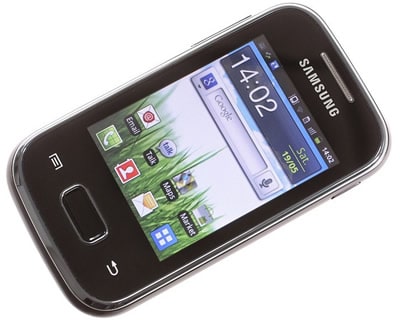
Manual-User-Guide.com > Samsung phones › Specs Samsung Galaxy Pocket
| Main display: TFT 256k colors 240 x 320 px (2.80″) 143 ppi |
| Android 2.3.6 Gingerbread |
| Broadcom BCM21553 832 MHz |
| Li-Ion 1200 mAh |
| Internal memory: 4 GB |
| RAM memory: 384 MB |
| 2 Mpx, 1600x1200 px |
154 User Reviews
| Other names: | GT-S5300 |
| Dimensions: | 103,7 x 57,5 x 12 mm |
| Weight: | 97,20 g |
| GSM frequencies: | 850/900/1800/1900 |
| Standard UMTS: | 900/2100 |
| Standard battery: | Li-Ion 1200 mAh |
| Stand-by (max.): | 2G: 800 h 3G: 500 h |
| Talk time (max.): | 2G: 17 h 3G: 5,6 h |
| Internal memory: | 4 GB |
| RAM memory: | 384 MB |
| Memory cards: | microSD, microSDHC, max 32 GB |
| Operating system: | Android 2.3.6 Gingerbread |
| Processor: | Broadcom BCM21553 832 MHz |
| Main display: | TFT 256k colors 240 x 320 px (2.80″) 143 ppi |
| Touchscreen: | Yes |
| Digital camera: | 2 Mpx, 1600x1200 px |
| Video: | H.263, H.264, MPEG4 - 15 fps, 320x240 px |
| MP3: | Yes |
| Radio: | Yes |
| Dictionary: | Yes, T9 |
| EMS: | - |
| MMS: | Yes |
| Speakerphone: | Yes |
| Voice dial: | Yes |
| Call forwarding: | Yes |
| e-mail client: | Yes |
| RSS Reader: | Yes |
| IrDA: | - |
| Bluetooth: | Yes, v3.0 |
| GPRS: | Yes, class 12 |
| EDGE: | Yes, class 12 |
| WiFi: | Yes, v802.11 b/g/n |
| Hotspot WiFi: | Yes |
| WAP: | Yes, v2.0 |
| xHTML: | Yes |
| HSCSD: | - |
| HSDPA: | Yes, 3,6 Mb/s |
| HSUPA: | Yes |
| HSPA: | Yes |
| HSPA+: | - |
| LTE: | - |
| WiMAX: | - |
| USB | Yes, v2.0 |
| GPS: | Yes |
| Push To Talk: | - |
| Java: | Yes, Dalvik |
| Calendar: | Yes |
| Watch: | Yes |
| Recorder: | Yes |
| Alarm: | Yes |
| Stopwatch: | Yes |
| Organizer: | Yes |
| Calculator: | Yes |
| Polyphony: | Yes, 64 głos. |
Mobile terms glossary
GSM stands for Global System for Mobile Communication and is the most popular 2G mobile phone standard in the world.
GSM is used by about 80% of all mobile phones - approximately 2 billion people across more than 212 countries.
The widespread use of the GSM standard has made it easy for most mobile phone users to use their phones overseas thanks to roaming agreements between operators using the same GSM standard.
GSM - then labelled Groupe Spécial Mobile was originally conceived back in 1982 as a European standard for mobile phones. The first GSM network went live in 1992 in Finland.
GSM introduced the concept of the SIM card (Subscriber Identity Module card) - a detachable smart card that lets users swap their phone number and contacts between handset.
3G - Analog cellular phones were the first generation while digital marked the second generation.3G is loosely defined, but generally includes high data speeds, always-on data access, and greater voice capacity.
The high data speeds are possibly the most prominent feature, and certainly the most hyped. They enable such advanced features as live, streaming video.
There are several different 3G technology standards. The most prevalent is UMTS, which is based on WCDMA (the terms WCDMA and UMTS are often used interchangeably).
Bluetooth is a low-power wireless networking technology operating in the 2.4 GHz unlicensed Industrial, Scientific and Medical (ISM) band. There are two classes of Bluetooth device — Class 1 devices have higher output power and a range of about 100 meters, and Class 2 devices have lower power and a range of about 10 meters. Bluetooth enables ad hoc networking of up to eight devices (supporting voice and data). The Bluetooth Special Interest Group (SIG) was founded in 1998 by IBM, Intel, Ericsson, Nokia and Toshiba, and is supported by more than 2,500 organizations. The Bluetooth v.1.0 specification was ratified and published in 1999 and supported data rates of up to 1Mbps. Bluetooth Version 2.1, along with its enhanced data rate (EDR) specification, was ratified in March 2007, supporting data rates of up to 3 Mbps, and simplified “pairing” — the process used for securely linking one Bluetooth device to another. It also reduced power consumption, doubling the battery life of headsets and other mobile devices for which the Bluetooth radio consumes a large percentage of the power budget. Version 3.0 (“Seattle”) was adopted by the SIG in April 2009, and the specification included Wi-Fi as an alternative transport layer for large volumes of data, supporting data rates of up to 24 Mbps. The SIG also adopted “Bluetooth low energy,” a new ultra-low-power variant, previously referred to as Ultra Low Power (ULP) Bluetooth and Wibree.
GPRS stands for General Packet Radio Service and was the first popular data standard for mobile phones.
GPRS was used for WAP and MMS messages and offered modest connection speeds - typically 30-40 Kbit/s, although the theoretical maximum is 115 Kbit/s. GPRS is known as a 2.5G technology.
One of the early advantages of GPRS is that it s always on so no connection handshake is needed. It is still very popular, especially in the developing world.
The name of EDGE in full is Enhanced Data rates for GSM Evolution. This is a 2.75G technology further developed from the 2G and 2.5G technologies. Its data transmission speed is higher than that of GPRS and is closer to 3G technology.
Wi-Fi is a WLAN (Wireless Local Area Network) technology. It provides short-range wireless high-speed data connections between mobile data devices (such as laptops, PDAs or phones) and nearby Wi-Fi access points (special hardware connected to a wired network).
The older variant of Wi-Fi, 802.11g, is capable of providing speeds of up to 54Mbps and is backwards compatible with 802.11b (providing up to 11Mbps).
The more recent standard is called 802.11n (offering speeds of up to 150Mbps per channel or up to 600Mbps in total). It can be used in the 2.4 GHz or 5 GHz frequency bands, though a receiver needs to have dual-band antenna to operate on both.
Universal Serial Bus (USB) is a serial bus standard to interface computer peripherals. USB is quickly replacing the need for serial and parallel ports to interface devices.